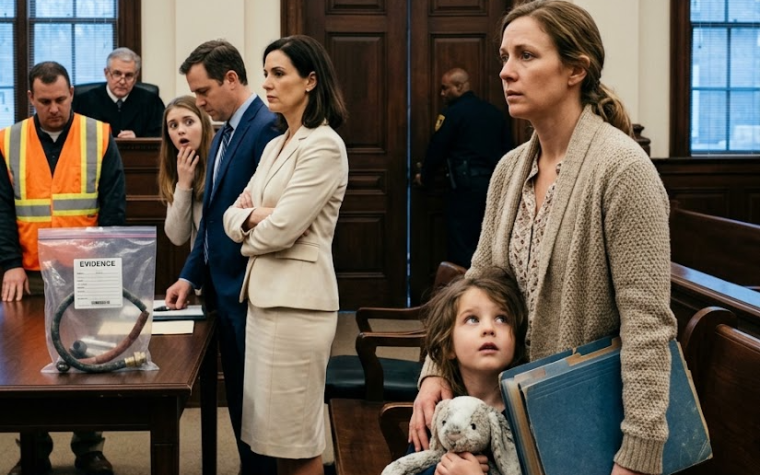
So she gave the true one.
“Yes.”
Nathan was quiet.
“Why?”
Emma tightened her grip on Ethan’s hand.
“Because every time something happens with my son, I feel like I have to prove I’m still serious about my work.
When he had pneumonia, I answered emails from the hospital.
When his school calls, I apologize before I even know what’s wrong.
I’ve stopped mentioning him unless I have to.”
Her voice shook once.
“This morning I didn’t bring him here because I thought it was acceptable.
I brought him because every other door was closed, and I thought if he could sit quietly for a few hours, I could keep earning our rent.”
Nobody interrupted her.
Emma looked down at Ethan.
“I just didn’t expect him to hear me begging for my job.”
Nathan’s eyes moved around the room, from the small backpack to the untouched crackers to the cluster of adults gathered at the door.
When he spoke, he didn’t raise his voice.
That made everyone listen harder.
“No one in this company will ever apologize for being a mother again.”
Lauren’s face tightened.
Nathan continued before anyone could mistake the statement for sentimentality.
“That doesn’t mean policies disappear.
It doesn’t mean employees can ignore workplace requirements.
It means an emergency involving a child is handled like an emergency involving a human being, not a character defect.”
He looked directly at HR.
“Emma’s termination is rescinded pending review.
She is paid for today.
Her performance record will be examined separately from any legitimate attendance issues, and this incident will not be described as misconduct unless the review establishes actual misconduct.”
Then he looked at Lauren.
“Your handling of the termination will also be reviewed.”
Lauren’s chin lifted.
“For enforcing policy?”
“For bypassing HR, ignoring the discretion written into that policy, and telling an employee that her ‘single-mother emergencies’ were the problem.”
Lauren went completely still.
The phrase had been spoken privately in her office.
Emma hadn’t repeated it to Nathan.
But someone had heard enough through the glass wall to confirm it when Nathan asked questions.
One of Emma’s coworkers, a woman named Rachel from accounting, finally stepped into view.
Her face was uncomfortable, but her voice was steady.
“I heard it.
I was walking past Lauren’s office.”
Another employee slowly nodded.
“So did I.”
The silence that had humiliated Emma twenty minutes earlier changed shape.
It was no longer protecting Lauren.
Lauren looked toward them in disbelief.
“You were listening outside my office?”
Rachel shook her head.
“You weren’t exactly whispering.”
Nathan ended the argument with one look.
The review took longer than anyone expected, but its conclusion was straightforward.
Emma had violated the visitor policy, yet management had discretion to handle emergency circumstances without immediate termination.
Her documented work remained strong.
Lauren had skipped the required HR consultation and had allowed frustration over Emma’s family-related absences to shape a disciplinary decision far beyond what the record supported.
The invoice discrepancies in Emma’s folder proved important for another reason.
They weren’t evidence of fraud or some dramatic conspiracy.