Brooklyn pointed again.
“She pulled it a little.
The machine made a sound.
Grandma jumped.
Then she pushed it back and left.”
My whole body turned cold.
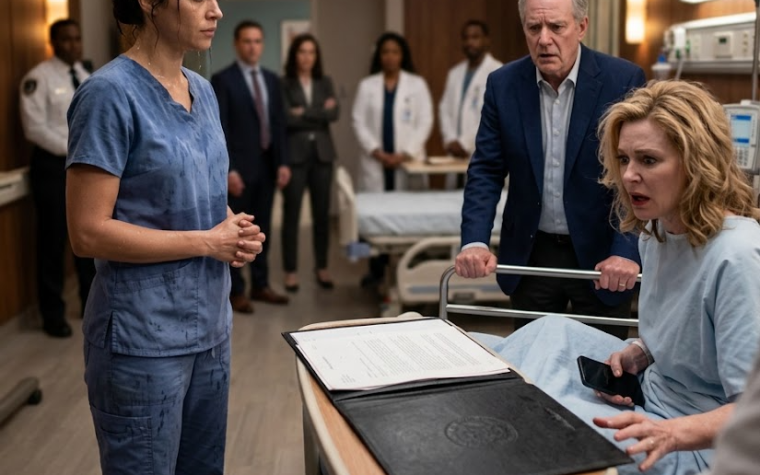
The charge nurse entered first, followed by a hospital security officer.
Gloria quickly moved them into the hall before discussing details where Brooklyn could hear.
I wanted to follow, but I could not leave Rosalie.
So I sat between my two daughters, one in a recliner and one inside an incubator, while strangers investigated whether my own mother had interfered with the machine keeping my newborn breathing.
Brooklyn started crying silently.
I pulled her against me despite the pain in my abdomen.
“You didn’t do anything wrong,” I told her.
“You helped Rosalie by telling me.”
“Why would Grandma touch it?”
I had no answer a six-year-old should have had to hear.
“I don’t know.”
That was the truth.
I knew my mother could be cruel.
I knew she could punish people for denying her control.
I knew she could say vicious things and then insist everyone else was too sensitive.
But touching medical equipment connected to a premature newborn crossed a line I had never imagined even she would cross.
Gloria returned about ten minutes later with the charge nurse.
“We’re checking the door-access records and security cameras,” the charge nurse said.
“Your mother was not listed as an approved visitor.
We need to determine how she entered.”
“Can those records tell you?”
“They can tell us when the secured door opened.
Cameras cover the hall and entrance.
They do not record inside patient rooms.”
My eyes moved to Brooklyn.
The charge nurse followed my gaze.
“Your daughter’s account matters.
So does the equipment history.”
Gloria showed me the timeline without letting Brooklyn see the screen.
At 2:47 a.m., Rosalie’s ventilator had recorded a brief change in circuit pressure.
It lasted only seconds before normal readings returned.
Gloria had been assisting another nurse nearby and had come back to find Rosalie stable.
Because premature babies moved, tubes shifted, and alarms happened, there had been no obvious reason at the time to suspect interference.
Now there was.
At 2:46 a.m., according to security, the NICU door had opened.
One minute before the alarm.
I felt nauseated.
“How did she get through the door?”
The security officer returned with the answer.
My mother had waited near the entrance until another family was leaving.
When the controlled door opened, she slipped through before it closed.
A camera showed her clearly.
Silver hair.
Black coat with the satin collar.
Large purse over one shoulder.
She had walked directly down the hall toward Rosalie’s room.
Four minutes later, another camera showed her leaving quickly.
Brooklyn had not dreamed it.
My mother had been there.
Security asked whether I wanted the incident formally documented.