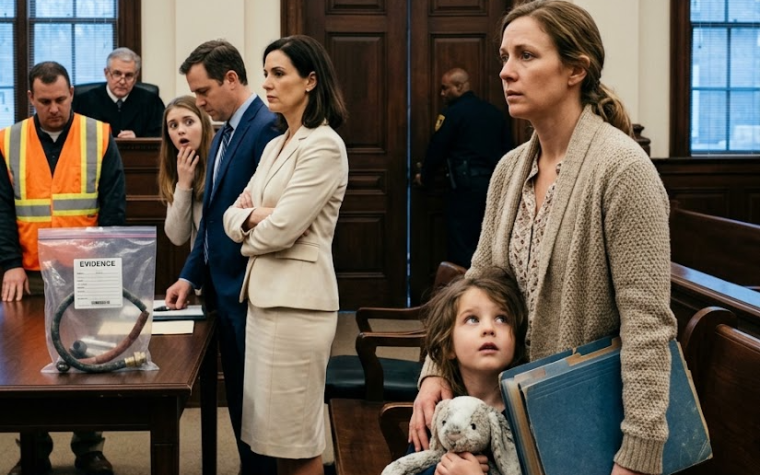
I opened the folder and began reading aloud.
“Declaration of Raymond Elias Mercer regarding prior financial claims made by Declan Mercer.”
Declan’s face lost its color.
The attorney beside him, Martin Vale, stopped reaching for the settlement agreement and looked directly at my brother.
“You told me there were no prior agreements,” he said.
Declan’s eyes stayed on the page in my hand.
“There weren’t.”
I turned the document toward him.
His signature appeared at the bottom of the second page, beside a notary stamp dated three years earlier.
I had never seen the document before that afternoon.
Gerald had not explained what was inside the sealed folder.
He had only told me to open it when someone gave me a reason.
Now I understood why.
Three years earlier, Declan’s real-estate business had nearly collapsed.
He had borrowed against two properties, missed several payments, and concealed the problem until foreclosure notices arrived.
Uncle Raymond had given him one hundred twenty-five thousand dollars.
Not loaned.
Given.
In return, Declan had signed a release acknowledging that the payment was an advance in full satisfaction of any claim he might later make against Raymond’s estate.
The language was painfully clear.
Declan had received his share while Raymond was alive.
He had agreed that Raymond owed him nothing more.
He had also affirmed that the payment was voluntary, that he had consulted independent counsel, and that he would not challenge any future trust, will, beneficiary designation, or transfer Raymond chose to make.
Martin held out his hand.
“Let me see that.”
I gave him a copy, not the original.
Gerald had prepared three duplicate sets and told me never to surrender the signed packet to anyone.
Martin read the first page, then the second.
His expression changed slowly, not with surprise but with the controlled anger of someone realizing his client had placed him in danger.
“Is this your signature?” he asked.
Declan stood.
“I was under pressure.”
“The document says you selected your own attorney.”
“That attorney was useless.”
“It says you had fourteen days to review the agreement.”
“I needed the money.”
Martin looked up.
“Needing money does not make a notarized release disappear.”
Declan turned toward me as though the document were something I had personally created to humiliate him.
“You knew about this?”
“No.”
“Then how convenient that you walked in carrying it.”
“I walked in carrying it because Raymond expected you to do exactly what you’re doing.”
His mouth tightened.
I looked down at the next page.
It was a contact log compiled by Gerald’s office.
Every call, email, and unexpected visit Declan had made to Raymond during the final eighteen months of his life had been dated and summarized.
At first, the entries looked ordinary.
Requests for meetings.
Questions about the packaging company.
Offers to help manage the Asheville property.
Then the tone changed.
Declan had asked whether Raymond’s will was current.
He had suggested that unmarried people without children were often taken advantage of by distant relatives.
He had asked whether Raymond still trusted Gerald.
He had offered to introduce him to a different estate attorney.