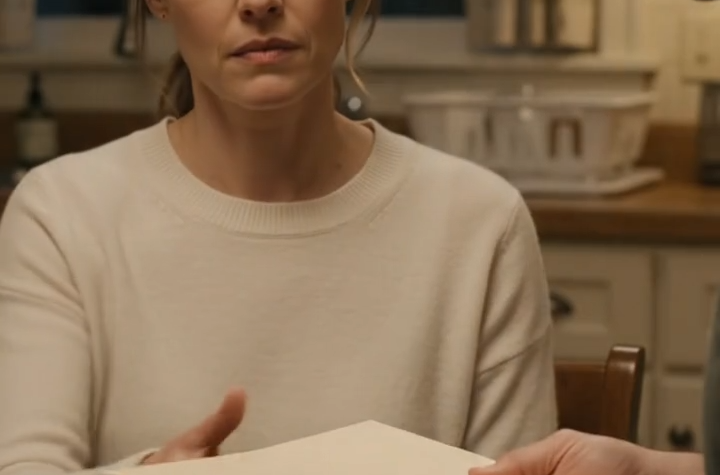
The smile vanished from Wyatt’s face before he reached the final stair.
He stared at Harrison as though his father had stepped out of a locked room instead of walking into the kitchen through the front door.
“What are you doing here?” Wyatt asked.
Harrison remained seated.
His dark coat hung across the back of the chair, and one hand rested on the brown folder beside his untouched coffee.
“Sit down, son.”
Wyatt looked at me.
The confidence returned to his face in pieces.
First the lifted chin.
Then the narrowed eyes.
Finally, the little contemptuous smile he had perfected during the years when I surrendered simply to keep the peace.
“You called him?”
I set a plate of eggs on the table.
“I did.”
“Because we had an argument?”
Harrison’s gaze moved to the swelling along my cheek.
“That wasn’t an argument,” he said.
Wyatt pulled out a chair but did not sit.
He stood behind it with both hands gripping the wooden back.
“You don’t know what happened.”
“I know you hit your mother.”
“She kept pushing me.”
The words came so quickly that Wyatt seemed not to hear what he had admitted.
I did.
So did Harrison.
For years, I had imagined that if Wyatt ever crossed that final line, he would be horrified by himself.
I had pictured tears, apologies and promises made on his knees.
Instead, he stood at my breakfast table explaining why I had deserved it.
Harrison opened the folder.
The first page was a certified copy of the deed to the house.
Wyatt glanced at it and laughed.
“What is this supposed to be?”
“Read the name,” Harrison said.
Wyatt looked again.
My name appeared as the sole owner.
After the divorce, Harrison had transferred his share of the Savannah house to me.
I had paid the mortgage, the insurance, the repairs and the taxes.
Wyatt had never contributed more than a few grocery bags and promises that disappeared by payday.
Still, somewhere along the way, he had begun calling the house his.
His room.
His kitchen.
His rules.
His mother to command.
“I live here,” he said.
“You were allowed to live here,” I answered.
His fingers tightened around the chair.
“This is my home too.”
“No,” I said.
“It is the home where I kept rescuing you from the consequences of your choices.”
Harrison removed a second document.
It was the property settlement from our divorce, followed by copies of the payments I had made alone for years.
Behind those pages, I had added my own records during the long hours before dawn: bank transfers to Wyatt, photographs of the broken glasses, receipts for the door he had kicked and a picture of the bruise forming on my face at 1:33 that morning.
The final photograph showed the kitchen counter where my hand had gripped the edge after he struck me.
Wyatt stared at the stack.
“You’ve been building a case against me?”
“No,” I said.